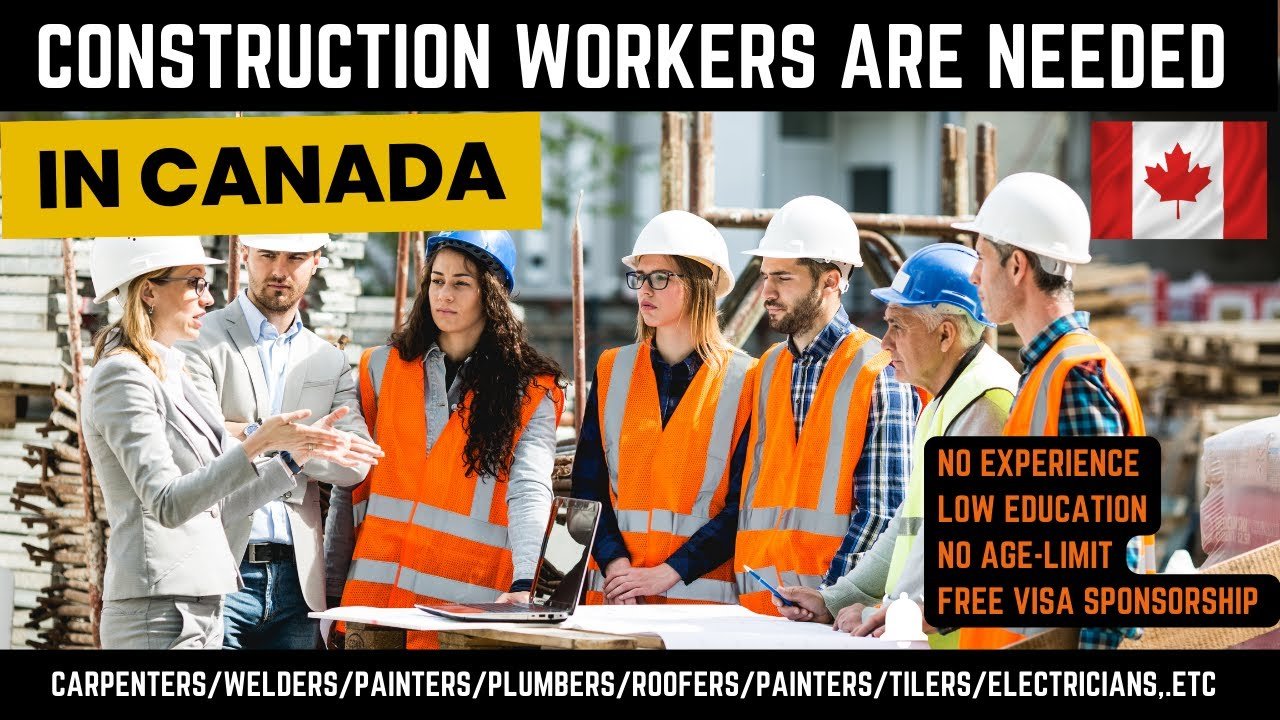
Canada is facing one of the most severe skilled labour shortages in its modern history, and the construction sector is at the epicentre. According to BuildForce Canada, the industry will need to recruit over 299,000 new workers by 2032 just to replace retirees and meet infrastructure demand. With the federal government having committed over $180 billion in infrastructure investment through its National Housing Strategy and the Investing in Canada Plan, the demand for skilled construction workers has never been higher.
For internationally trained skilled workers from Pakistan, India, Nigeria, the Philippines, and Bangladesh, this represents a generational opportunity. Canadian employers are now actively pursuing employer-sponsored work visas, filing Labour Market Impact Assessments (LMIAs), and partnering with immigration consultants to fast-track foreign nationals into trades roles that pay between CAD $55,000 and $130,000 per year — with a direct pathway to permanent residence.
This guide breaks down exactly which construction roles are hiring, what salaries look like in each province, which visa sponsorship programs apply, and how to navigate the Canadian immigration system as a skilled tradesperson. Whether you are a civil engineer, electrician, welder, ironworker, or heavy equipment operator, the information here will give you a clear, actionable roadmap.
🌍 More Available Jobs
Quick-Reference Summary Table: Construction Jobs in Canada With Visa Sponsorship
| Job Title | NOC Code | Average Salary (CAD/yr) | Visa Program | PR Pathway | Experience Required |
|---|---|---|---|---|---|
| Construction Project Manager | 70010 | $90,000–$130,000 | LMIA, Express Entry | FSW, PNP | 5+ years |
| Electrician (Industrial/Commercial) | 72200 | $75,000–$105,000 | LMIA, PNP | Federal Skilled Trades | 3+ years |
| Plumber | 72300 | $70,000–$100,000 | LMIA, PNP | Federal Skilled Trades | 3+ years |
| Ironworker / Structural Steel | 72103 | $72,000–$98,000 | LMIA, PNP | Federal Skilled Trades | 2+ years |
| Heavy Equipment Operator | 73400 | $65,000–$92,000 | TFWP/LMIA | PNP, AIP | 2+ years |
| Welder | 72106 | $60,000–$88,000 | LMIA, PNP | Federal Skilled Trades | 2+ years |
| Concrete Finisher | 72113 | $58,000–$80,000 | TFWP/LMIA | PNP, AIP | 1+ years |
| Carpenter | 72310 | $60,000–$85,000 | LMIA, PNP | Federal Skilled Trades | 2+ years |
| Civil / Structural Engineer | 21300 | $85,000–$120,000 | Express Entry | CEC, FSW | 3+ years |
| Construction Estimator | 22302 | $72,000–$98,000 | LMIA, Express Entry | CEC, PNP | 3+ years |
Apply for an Abroad Job Today
Fill out this form to apply. Our team reviews all applications and will contact shortlisted candidates within 3–5 working days.
Application Submitted!
Congratulations! We have received your application. Our team will review it and reach out to shortlisted candidates.
✅ Step 1: Application received — done!
🕑 Step 2: Our team reviews your profile (3–5 working days)
📞 Step 3: Shortlisted candidates get contacted via WhatsApp/email
🎓 Step 4: Visa sponsorship process begins
Check your email and WhatsApp regularly. Good luck!
Full Salary and Benefits Breakdown for Construction Roles in Canada
Understanding compensation in Canada requires looking beyond the base salary. Most construction employers offering visa sponsorship jobs in Canada also provide a total compensation package that significantly raises the effective value of the offer.
| Role | Base Salary (CAD) | Overtime Potential | Benefits Package Value | Relocation Allowance | Total Estimated Value |
|---|---|---|---|---|---|
| Construction Project Manager | $90,000–$130,000 | $10,000–$25,000 | $8,000–$15,000 | $5,000–$10,000 | $113,000–$180,000 |
| Electrician | $75,000–$105,000 | $12,000–$22,000 | $7,000–$12,000 | $3,000–$8,000 | $97,000–$147,000 |
| Plumber | $70,000–$100,000 | $10,000–$20,000 | $7,000–$12,000 | $3,000–$8,000 | $90,000–$140,000 |
| Ironworker | $72,000–$98,000 | $14,000–$24,000 | $6,000–$10,000 | $3,000–$7,000 | $95,000–$139,000 |
| Heavy Equipment Operator | $65,000–$92,000 | $8,000–$18,000 | $6,000–$10,000 | $3,000–$7,000 | $82,000–$127,000 |
| Welder | $60,000–$88,000 | $10,000–$20,000 | $5,000–$9,000 | $2,000–$6,000 | $77,000–$123,000 |
| Carpenter | $60,000–$85,000 | $8,000–$16,000 | $5,000–$9,000 | $2,000–$6,000 | $75,000–$116,000 |
| Civil/Structural Engineer | $85,000–$120,000 | $5,000–$15,000 | $10,000–$18,000 | $5,000–$12,000 | $105,000–$165,000 |
Standard benefits typically included:
- Extended health, dental, and vision coverage
- RRSP matching (up to 4–5% of base salary)
- Paid vacation (2–4 weeks starting)
- Safety gear and tool allowances ($500–$2,500/year)
- Training and certification reimbursement
- Relocation assistance packages (airfare, temporary housing, settling-in allowances)
Why Canada Has a Critical Construction Labour Shortage
Canada’s construction crisis is structural, not cyclical. Several compounding factors have created a labour gap that domestic hiring alone cannot fill — which is exactly why employer-sponsored work visas for construction roles are being processed faster than ever.
Demographic reality: The average age of a tradesperson in Canada is 43 years old. An estimated 25% of the current construction workforce will reach retirement age within the next decade. The Canadian Home Builders’ Association estimates that Canada needs to build 3.87 million additional homes by 2031 to restore housing affordability — an almost impossible target without international recruitment.
Infrastructure expansion: The federal government’s infrastructure pipeline includes LRT expansions in Calgary, Edmonton, and Vancouver; new transit corridors in Toronto; hydroelectric projects in Quebec and Newfoundland; and liquefied natural gas (LNG) terminal development in British Columbia. Each of these projects demands thousands of skilled tradespeople for multi-year durations.
Training pipeline gaps: Canada’s college and apprenticeship system produces approximately 50,000 certified tradespeople annually — far short of the 90,000+ needed each year to meet combined replacement and growth demand. The National Apprenticeship Strategy acknowledges this deficit explicitly.
Immigration as policy response: The Government of Canada has responded by increasing immigration targets for skilled trades under Express Entry’s Federal Skilled Trades Program, expanding the Provincial Nominee Program (PNP) allocations for construction workers, and allowing employers to obtain LMIA-approved jobs more quickly for certain trade categories.
For international workers, this means that Canada is not simply tolerating foreign construction workers — it is actively designing immigration pathways to bring them in.
Types of Visa Sponsorship Programs for Construction Workers
Understanding which immigration pathway is right for your situation is essential. Below is a comprehensive breakdown of the main programs that facilitate employer sponsored work visa arrangements for construction professionals.
1. Temporary Foreign Worker Program (TFWP) with LMIA
The Temporary Foreign Worker Program is the primary route for employers who want to hire specific foreign nationals for defined roles. Before extending a job offer, the employer must obtain a Labour Market Impact Assessment (LMIA) from Employment and Social Development Canada (ESDC), proving that no qualified Canadian citizen or permanent resident was available for the position.
For construction, this is the most common starting point for workers from South Asia, Africa, and Southeast Asia. A positive LMIA allows the worker to apply for a work permit Canada (construction category). Processing times for construction LMIA applications currently average 4–8 weeks for high-demand roles.
Key facts:
- Employer bears the LMIA application fee ($1,000 CAD)
- Work permit is employer-specific (tied to that employer initially)
- Duration typically matches the employment contract (1–3 years)
- Can be extended and eventually leads to PR through employer retention
2. Express Entry — Federal Skilled Trades Program (FSTP)
The Federal Skilled Trades Program under Express Entry is a permanent residence pathway designed specifically for certified tradespeople. Successful applicants receive Canadian permanent residence directly, without needing a prior work permit — though having a job offer increases the Comprehensive Ranking System (CRS) score significantly.
Eligible occupations include: electricians, plumbers, ironworkers, welders, heavy equipment operators, carpenters, and many other NOC TEER 2 and TEER 3 construction trades.
Minimum requirements:
- At least 2 years of full-time work experience in a skilled trade within the past 5 years
- A job offer from a Canadian employer OR a certificate of qualification from a Canadian provincial authority
- Meet language requirements (CLB 5 for speaking and listening; CLB 4 for reading and writing)
- Not required to meet the educational requirements that apply to the Federal Skilled Worker stream
CRS scores for Federal Skilled Trades draws have historically been lower than FSW draws, making this an accessible route even for workers without post-secondary degrees.
3. Provincial Nominee Program (PNP)
Every province and territory operates its own Provincial Nominee Program, many of which include dedicated streams for construction and skilled trades workers. A provincial nomination adds 600 CRS points to an Express Entry profile, virtually guaranteeing an Invitation to Apply (ITA) for permanent residence.
Key provincial streams for construction workers include:
- Alberta Advantage Immigration Program (AAIP) — Skilled Worker stream: Targets workers already employed in Alberta in NOC TEER 2–5 occupations including most construction trades.
- British Columbia PNP — Skilled Worker and International Post-Graduate streams: BC prioritizes workers in construction, LNG, and infrastructure sectors with active employer support.
- Ontario Immigrant Nominee Program (OINP) — Employer Job Offer stream: Requires a full-time, permanent job offer from an Ontario employer in a NOC TEER 0–3 occupation.
- Saskatchewan Immigrant Nominee Program (SINP): One of the most active programs for construction tradespeople, including concrete finishers, roofers, and equipment operators.
- Atlantic Immigration Program (AIP): Covers Nova Scotia, New Brunswick, PEI, and Newfoundland. Employers in these provinces are designated to hire international workers and support their permanent residence applications.
- Manitoba Provincial Nominee Program (MPNP) — Skilled Workers Overseas: Supports construction workers with a Manitoba job offer and demonstrates active provincial recruitment in housing and infrastructure.
4. Global Talent Stream (GTS)
The Global Talent Stream is a fast-track work permit program primarily used for engineering and technical roles within construction and infrastructure. It offers a 2-week processing guarantee for eligible positions and is particularly relevant for civil engineers, project managers, and construction technology specialists.
GTS is administered under the TFWP but operates with streamlined processes and no LMIA advertising requirement for Category A (referred by a designated partner) applicants. For Category B roles, which includes many senior construction management and engineering positions, employers must demonstrate the role is on the eligible occupations list.
5. Intra-Company Transfer and International Agreements
Workers employed by multinational construction companies may qualify for intra-company transfers to Canadian operations under CUSMA (formerly NAFTA) or other bilateral agreements. This pathway is particularly relevant for project managers and senior engineers from companies with Canadian subsidiaries.
Construction Job Roles: Detailed Breakdown by Specialty
Construction Project Manager
Construction project managers in Canada oversee residential, commercial, and infrastructure projects from pre-construction planning through handover. They coordinate subcontractors, manage budgets, and ensure regulatory compliance.
Salary range: CAD $90,000–$130,000/year, with senior roles at major contractors exceeding $150,000 including bonuses.
NOC Code: 70010 (TEER 0)
Visa eligibility: Express Entry (FSW), PNP Employer Job Offer streams, LMIA. A degree in civil engineering, construction management, or architecture combined with PMP or Gold Seal certification dramatically strengthens the application.
Top hiring provinces: Ontario, British Columbia, Alberta
Electrician (Industrial and Commercial)
Industrial and commercial electricians are among the most in-demand trades workers in Canada. They install, maintain, and repair electrical systems in commercial buildings, industrial facilities, and infrastructure projects.
Salary range: CAD $75,000–$105,000/year. Journeyperson electricians in Alberta regularly earn over $100,000 with overtime.
NOC Code: 72200 (TEER 2)
Visa eligibility: Federal Skilled Trades Program (Express Entry), PNP skilled worker streams in Alberta, BC, Saskatchewan, and Ontario. An LMIA pathway is also common for employer-specific hires.
Certification note: Workers must obtain provincial certification (Red Seal if interprovincially recognized). Many provinces allow foreign-trained electricians to write a challenge exam rather than completing a full apprenticeship.
Plumber
Plumbers are consistently among the highest-earning tradespersons in Canada. They are employed in residential, commercial, and industrial construction, as well as municipal infrastructure.
Salary range: CAD $70,000–$100,000/year. In British Columbia and Alberta, certified plumbers earn up to $120,000 with shift work or northern allowances.
NOC Code: 72300 (TEER 2)
Visa eligibility: Federal Skilled Trades Program, PNP. The Red Seal interprovincial certification is highly valued and facilitates mobility across provinces.
Ironworker / Structural Steel Worker
Ironworkers erect the structural frameworks of buildings, bridges, and industrial plants. The role is physically demanding but compensates with among the highest hourly rates in the trades, particularly in union environments.
Salary range: CAD $72,000–$98,000/year. Union ironworkers on large infrastructure projects in Ontario and BC can exceed $110,000 with overtime and travel pay.
NOC Code: 72103 (TEER 2)
Visa eligibility: Federal Skilled Trades Program, LMIA, PNP. The International Association of Bridge, Structural, Ornamental and Reinforcing Iron Workers (IABSORIW) union actively supports the hiring of qualified foreign ironworkers for major Canadian projects.
Heavy Equipment Operator
Heavy equipment operators run bulldozers, cranes, excavators, graders, and other machinery essential to site preparation, road construction, and large-scale infrastructure projects. Demand is acute in Alberta’s oil sands region, British Columbia’s resource sector, and across all provinces undertaking housing development.
Salary range: CAD $65,000–$92,000/year. Crane operators — a specialized subset — regularly earn $95,000–$120,000. Northern allowances can add $15,000–$30,000 per year.
NOC Code: 73400 (TEER 3)
Visa eligibility: TFWP with LMIA, PNP (Saskatchewan, Alberta, Manitoba). Workers from countries with established construction industries (Philippines, India) are particularly well-represented in this category.
Welder
Welders are critical to pipeline construction, LNG facility development, manufacturing facilities, and structural steel work. Canada’s oil and gas infrastructure — particularly in Alberta and Saskatchewan — relies heavily on certified welders.
Salary range: CAD $60,000–$88,000/year. Pipeline welders and those certified to CWB (Canadian Welding Bureau) standards can earn $95,000–$130,000 on major project sites.
NOC Code: 72106 (TEER 2)
Visa eligibility: Federal Skilled Trades Program, LMIA, PNP. CWB certification is recognized as the gold standard for Canadian employers and significantly accelerates credential recognition.
Carpenter
Carpenters work in residential, commercial, and industrial construction, with specializations including formwork, finishing, and cabinet making. The current housing construction boom has placed carpenters in extreme demand across all provinces.
Salary range: CAD $60,000–$85,000/year, with formwork carpenters on large commercial projects earning up to $95,000.
NOC Code: 72310 (TEER 2)
Visa eligibility: Federal Skilled Trades Program, LMIA, PNP. The United Brotherhood of Carpenters and Joiners of America (UBC) Canada has programs to assess and certify foreign-trained carpenters.
Civil and Structural Engineer
Civil and structural engineers design and oversee roads, bridges, transit systems, water treatment facilities, and building foundations. They are among the highest-compensated professionals in Canada’s construction sector.
Salary range: CAD $85,000–$120,000/year, rising to $140,000+ with project leadership responsibilities.
NOC Code: 21300 (TEER 1)
Visa eligibility: Express Entry (Federal Skilled Worker), Global Talent Stream, PNP (Employer Job Offer streams). Engineers must apply for membership with the provincial engineering association (P.Eng. designation) to practise independently, though many employers hire internationally trained engineers in non-autonomous roles while they pursue licensure.
Top Provinces and Employers Actively Hiring International Construction Workers
Alberta
Alberta remains the most aggressive province in recruiting international construction workers. The oil sands, LNG Canada project spin-offs, and the provincial government’s 10-year capital plan are driving demand for every trade category. Major employers actively filing LMIA-approved jobs include PCL Constructors, Ledcor Group, Graham Construction, and Bird Construction. Alberta’s wage rates are among the highest in Canada, and the province does not levy provincial income tax.
British Columbia
British Columbia’s LNG Canada terminal in Kitimat, the Site C hydroelectric dam project, and Metro Vancouver’s transit expansion are employing thousands of skilled tradespeople. The BC PNP Skills Immigration stream actively supports construction workers. Major employers include EllisDon, Aecon Group, Kiewit, and Fluor Canada.
Ontario
Ontario’s construction boom — driven by housing targets, the Metrolinx transit expansion (Eglinton Crosstown, Ontario Line), and hospital redevelopment programs — makes it the single largest market for construction employment in the country. The OINP Employer Job Offer stream is one of the most utilized PNP pathways for skilled construction workers. Key employers include Maple Reinders, Eastern Construction, Bondfield Construction, and Turner Construction.
Saskatchewan
Saskatchewan offers one of the most straightforward provincial nomination processes for construction workers via the SINP. The province is also building potash processing facilities and renewable energy infrastructure. Employers include Graham Construction, SNC-Lavalin (now AtkinsRéalis), and various Indigenous-owned construction enterprises.
Atlantic Canada (Nova Scotia, New Brunswick, PEI, Newfoundland)
The Atlantic Immigration Program (AIP) is a permanent-residence-first pathway available to workers offered jobs by designated Atlantic employers. The region is actively building affordable housing, upgrading port facilities, and developing offshore wind infrastructure. Lower cost of living combined with strong community supports make Atlantic Canada particularly attractive for families relocating from South Asia and West Africa.
Permanent Residence Pathways for Construction Workers
Federal Skilled Trades Program (FSTP)
This Express Entry stream is the primary PR pathway for certified trades workers. Unlike the Federal Skilled Worker stream, it does not require a minimum level of education — a critical advantage for workers whose credentials lie in trade certificates rather than university degrees. Workers can submit a profile at any time; invitation rounds are held multiple times per year.
Canadian Experience Class (CEC)
Workers who enter Canada on a work permit and accumulate at least one year of skilled Canadian work experience in a NOC TEER 0, 1, 2, or 3 occupation become eligible for the CEC. This is the most efficient PR pathway for construction workers already working in Canada on LMIA-supported work permits.
Provincial Nominee Program Streams
As detailed above, every province operates streams specifically designed to retain construction workers. For workers outside Canada, an employer-supported PNP nomination provides the fastest route to permanent residence — often within 6–12 months of nomination.
Atlantic Immigration Program (AIP)
Established as a permanent program in 2022, the AIP allows designated Atlantic employers to sponsor foreign nationals for permanent residence directly — without needing to go through Express Entry first. There is no CRS score requirement. The key eligibility criteria are a genuine job offer from a designated employer and meeting basic language (CLB 4) and education (one-year post-secondary) thresholds.
Rural and Northern Immigration Pilot (RNIP) / Rural Community Immigration Pilot
Several rural Canadian communities in Ontario, Manitoba, Saskatchewan, and British Columbia participate in targeted immigration pilots for construction workers, particularly in regions experiencing acute trades shortages. These programs facilitate community-based PR nominations for workers willing to settle in smaller municipalities.
Step-by-Step Guide: How to Apply for a Construction Job in Canada With Visa Sponsorship
Step 1: Assess your qualifications against NOC codes Identify the National Occupational Classification (NOC) code that matches your trade or profession. Visit the Government of Canada’s Job Bank at jobbank.gc.ca and confirm your role falls under TEER 0–3 for Express Entry eligibility or TEER 2–5 for TFWP/LMIA pathways.
Step 2: Get your credentials assessed Apply for an Educational Credential Assessment (ECA) through WES (World Education Services) if applying under Express Entry FSW, or contact the relevant provincial trades authority (e.g., ABSA in Alberta, Technical Standards and Safety Authority in Ontario) for trade certificate recognition. This process typically takes 4–12 weeks.
Step 3: Take a language test Write the IELTS General Training or CELPIP exam. Most construction trades under FSTP require CLB 5 in speaking and listening, and CLB 4 in reading and writing. Engineers and project managers under FSW need CLB 7 overall.
Step 4: Create or optimize your Express Entry profile Register on the IRCC portal and create an Express Entry profile. Input your work experience, education, language scores, and any job offers. Use a qualified immigration consultant Canada (RCIC-licensed) or immigration lawyer to review your profile before submission — a poorly structured profile can cost you critical CRS points.
Step 5: Search for LMIA-approved job offers Use the Job Bank (jobbank.gc.ca), Indeed Canada, LinkedIn, and construction-specific platforms like BuildWork and Canadian Construction Association’s career portal. Filter for employers advertising LMIA approval or visa sponsorship. In your cover letter, explicitly note your immigration status and desire for employer sponsorship.
Step 6: Secure a job offer Once you receive a job offer from a Canadian employer willing to sponsor your work permit through the TFWP, the employer files the LMIA application. You do not need to pay for this — employer bears the $1,000 LMIA fee.
Step 7: Apply for your work permit After a positive LMIA is issued, you apply for a work permit Canada through the IRCC online portal. Include your job offer letter, LMIA number, passport, photographs, and any supporting documentation. Biometrics may be required at a Visa Application Centre (VAC) in your home country.
Step 8: Arrive in Canada and begin building PR eligibility Once in Canada on a work permit, begin accumulating Canadian work experience for CEC eligibility (minimum 1 year). Simultaneously, work with your employer on a PNP nomination if your province has an active construction stream. Maintain your Express Entry profile with updated CRS scoring.
Step 9: Apply for permanent residence Upon receiving an Invitation to Apply (ITA) — either through an Express Entry draw or a provincial nomination — submit your complete PR application within 60 days. Engage a licensed immigration consultant Canada or immigration lawyer to compile your documentation package accurately.
Frequently Asked Questions (FAQ)
Q1: What is the average salary for a construction worker in Canada in 2024?
Salaries vary significantly by trade and province. Entry-level labourers earn approximately CAD $40,000–$55,000 per year, while journeypersons in regulated trades (electricians, plumbers, ironworkers) earn $70,000–$105,000. Senior project managers and civil engineers earn $90,000–$140,000. Alberta and British Columbia consistently offer the highest wage rates due to high living costs and resource-sector competition for labour.
Q2: Can I get a construction job in Canada without a job offer through Express Entry?
Yes, but having a valid job offer significantly improves your CRS score. The Federal Skilled Trades Program allows draws without a job offer if you hold a valid certificate of qualification from a Canadian provincial authority. However, most international applicants are not yet certified provincially before arriving, making a job offer the most practical strategy to improve ranking.
Q3: How long does it take to get a work permit for a construction job in Canada?
Under the standard TFWP/LMIA process: LMIA processing takes 4–8 weeks, and the work permit application thereafter takes 4–8 weeks from outside Canada. Under the Global Talent Stream (for eligible engineering roles), the work permit is processed in approximately 2 weeks. Total timeline from accepted job offer to arrival in Canada typically ranges from 3–6 months.
Q4: Which construction trades are eligible for the Federal Skilled Trades Program?
Eligible trades under FSTP include: electricians, plumbers, steamfitters, pipefitters, gas fitters, sheet metal workers, ironworkers, welders, carpenters, concrete finishers, bricklayers, roofers, heavy equipment operators, and crane operators, among others. The full list corresponds to NOC TEER 2 trades (Major Group 72, 73) within the construction sector.
Q5: Do I need a Canadian work permit before applying for permanent residence?
Not necessarily. The Federal Skilled Trades Program and Federal Skilled Worker streams under Express Entry allow you to apply for permanent residence directly from abroad. However, having Canadian work experience (via a work permit) dramatically improves your CRS score and opens the Canadian Experience Class pathway, which has historically had lower CRS cutoffs for trades workers.
Q6: Can my family come with me if I get a construction work permit in Canada?
Yes. Spouses and common-law partners of construction workers on work permits (NOC TEER 0, 1, 2, and some TEER 3 occupations) are eligible for an open work permit — meaning they can work for any Canadian employer. Dependent children are eligible for study permits to attend Canadian schools. This is one of the most powerful features of the Canadian immigration system and a major draw for workers from Pakistan, India, Nigeria, and the Philippines.
Q7: Is there a minimum English language requirement for construction visa sponsorship in Canada?
For LMIA/TFWP work permit applications, IRCC does not impose a universal language test requirement, but employers frequently require functional English for safety compliance. For Express Entry (FSTP, FSW, CEC), language test results from IELTS or CELPIP are mandatory and carry significant CRS weight. A CLB 7+ in all four skills adds 128 points to a single applicant’s CRS score.
Q8: What is the role of a licensed immigration consultant in a construction visa application?
A Regulated Canadian Immigration Consultant (RCIC) can advise you on the optimal immigration pathway for your trade, review your Express Entry profile for accuracy, prepare your work permit or PR application package, represent you before IRCC, and liaise with potential employers on LMIA procedures. Unauthorized “consultants” or “visa agents” operating outside Canada are not regulated and carry a high risk of fraud. Always verify consultant credentials through the College of Immigration and Citizenship Consultants (CICC) registry at college-ic.ca.
Q9: Do Canadian construction employers provide relocation packages for international hires?
Many mid-to-large construction employers and labour-supply firms offering relocation package Canada support include return airfare, temporary housing for the first 30–90 days, a settling-in allowance of CAD $2,000–$5,000, and orientation support. Some employers, particularly those hiring under the Atlantic Immigration Program, offer structured relocation packages as part of their AIP designation requirements. Always negotiate relocation terms before accepting an offer, and confirm what is covered in writing.
Q10: What happens if my LMIA-supported job ends before I can apply for PR?
Workers on LMIA work permits can switch employers if they find a new employer willing to support a new work permit. Additionally, if you have accumulated sufficient Canadian work experience, you may be eligible to apply for an open work permit under the Maintained Status provisions while your Express Entry or PNP application is in progress. Consulting a licensed immigration professional is strongly advised if your employment situation changes before you reach PR status.
Take the Next Step: Your Construction Career in Canada Starts Now
Canada’s construction industry is not waiting — and neither should you. The convergence of a demographic labour crisis, record infrastructure spending, and an immigration system explicitly designed to admit skilled foreign tradespeople has created an opening that will not exist indefinitely. Government policy, employer urgency, and economic necessity are all aligned in your favour.
The pathway is clear: identify your NOC code, assess your credentials, take your language test, build a strong Express Entry profile, and pursue employer sponsorship through LMIA-approved channels. With the right support from a licensed immigration consultant and a legitimate Canadian employer, workers from Pakistan, India, Nigeria, the Philippines, and Bangladesh are arriving in Canada every month — earning Canadian wages, building Canadian infrastructure, and securing permanent residence for themselves and their families.
If you are serious about making this move, your next steps are:
- Visit jobbank.gc.ca and search for construction roles in your trade with LMIA sponsorship.
- Have your credentials assessed through WES (wes.org) or the relevant provincial trades authority.
- Register with the IRCC Express Entry pool at ircc.canada.ca.
- Consult a Regulated Canadian Immigration Consultant (RCIC) or Canadian immigration lawyer — verify credentials at college-ic.ca.
- Contact construction recruitment agencies active in your home country that specialize in skilled trades immigration Canada.
Canada is building. Make sure you are part of it.